

Cancer as Loss of the Cellular Light Network
© Courtney Hunt, MD, 2026
Multicellular life requires coordination. Every cell in the human body operates inside a regulated system that integrates metabolism, electrical gradients, mitochondrial function, and tissue-level growth control. These systems allow trillions of cells to function as a single organism.
Cancer develops when a cell loses integration with this system.
At its core, cancer is not simply uncontrolled growth. It is a failure of cellular communication, where a cell disconnects from the electrical and metabolic network that coordinates the body.
That network is fundamentally a flow of energy and light through biology.

Mitochondria: the cell’s light processors
Life on Earth ultimately runs on light.
Solar photons captured through photosynthesis are converted into chemical bonds. Those bonds are transferred through the food chain and eventually oxidized inside mitochondria. In human cells, mitochondria convert this stored solar energy into electron flow across the inner mitochondrial membrane.
Electron transport produces:
• ATP
• membrane potential
• redox signaling
• reactive oxygen species used for signaling
During these reactions, cells also emit ultra-weak photons known as biophotons. These emissions reflect the energetic state of the mitochondrial electron transport chain.
Healthy tissues maintain stable mitochondrial signaling and energy flow. This allows cells to coordinate growth, repair, and differentiation.
In this sense, mitochondria distribute biological light signals that help regulate cellular behavior.

Electrical organization of tissues
Cells also communicate through electrical gradients.
Ion channels maintain membrane potentials across the plasma membrane. Gap junctions formed by connexin proteins allow ions and small molecules to pass directly between neighboring cells. Through this network, tissues maintain coordinated electrical states.
These electrical gradients regulate:
• cell division
• differentiation
• tissue architecture
• regeneration boundaries
When electrical signaling remains intact, growth is tightly controlled.
In many cancers, however, these systems are disrupted.
Common findings include:
• reduced gap junction communication
• altered ion channel expression
• chronic membrane depolarization
Loss of electrical integration removes constraints on cell proliferation.
Cells begin dividing without responding to the surrounding tissue.
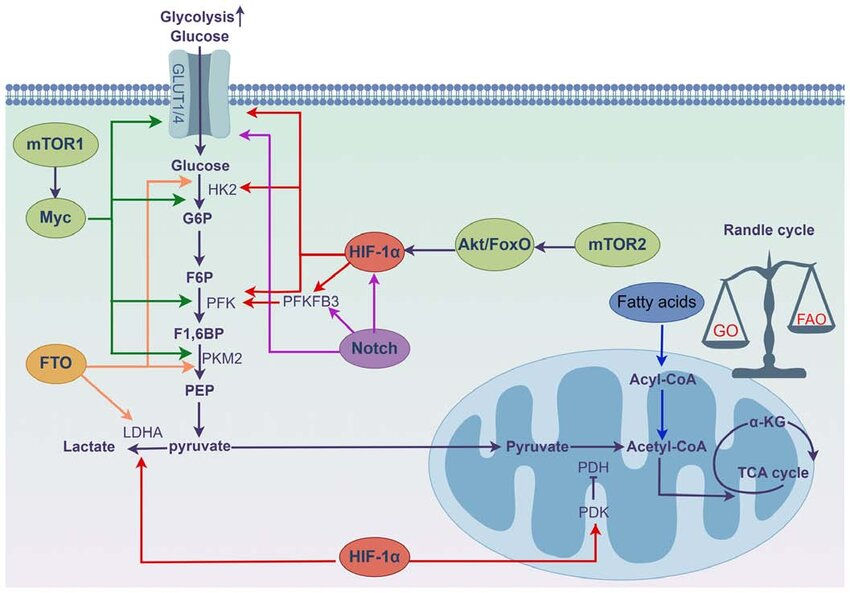
Metabolic shift and loss of mitochondrial regulation
Normal differentiated cells primarily generate energy through mitochondrial oxidative phosphorylation.
Cancer cells frequently shift toward glycolysis even in the presence of oxygen. This metabolic pattern is known as the Warburg effect.
This shift supports rapid biosynthesis by generating:
• nucleotides
• lipids
• amino acids
• metabolic intermediates for cell growth
At the same time, mitochondrial regulation becomes altered.
Electron transport becomes inefficient, redox signaling changes, and the normal relationship between mitochondrial energy production and tissue demand breaks down.
In practical terms, the cell has lost its connection to the organism’s energy network.

Reactivation of primitive growth programs
Many cancers reactivate developmental signaling pathways that normally operate during embryonic growth.
These pathways include:
• Wnt/β-catenin
• Hedgehog
• Notch
• Myc signaling
During embryogenesis these systems drive rapid tissue expansion. When reactivated in adult tissues, they stimulate uncontrolled proliferation.
The cell begins operating under growth programs designed for early development rather than adult tissue maintenance.

Cancer as cellular disconnection
When these processes combine, a fundamental shift occurs.
A normal cell participates in:
• mitochondrial energy flow
• electrical communication
• metabolic regulation
• organism-level signaling
Cancer cells progressively lose these connections.
The result is a cell that behaves autonomously. It consumes nutrients, redirects blood supply, and proliferates without contributing to the function of the organism.
Instead of participating in the cooperative network of multicellular life, the cell behaves more like an independent organism.
The role of light in biological organization
From a systems perspective, biological organization depends on energy flow.
Light from the sun drives the chemical reactions that build life. Mitochondria convert that stored energy into electrical gradients and biochemical signals that coordinate cellular behavior.
When mitochondrial function, redox balance, and electrical signaling remain intact, tissues maintain structural order.
When these systems fail, that order breaks down.
Cancer can therefore be viewed as a loss of coherent energy signaling within the organism.
The cell is no longer synchronized with the metabolic and electrical rhythms of the tissue.
It has lost its connection to the network that maintains biological order.

A systems view of cancer
Cancer is often described as a genetic disease. Mutations are important, but they occur within a broader context of cellular signaling.
A cell that remains integrated with the organism’s metabolic and electrical systems rarely becomes malignant.
Cancer emerges when those systems fail.
At that point the cell no longer behaves as part of the organism.
It becomes metabolically autonomous, electrically uncoupled, and resistant to regulatory signals.
In simple terms:
Cancer begins when a cell disconnects from the body’s light-driven energy network and begins operating for itself.
© Courtney Hunt, MD, 2026


Interesting article. Any references?